EPISODE ONE · LONG READ
You think you know Cain and Abel. You’ve been told what it means. We’re here to suggest, as respectfully as our nature allows, that you’ve barely scratched the surface.
By Rolo|Episode 1|May 2026
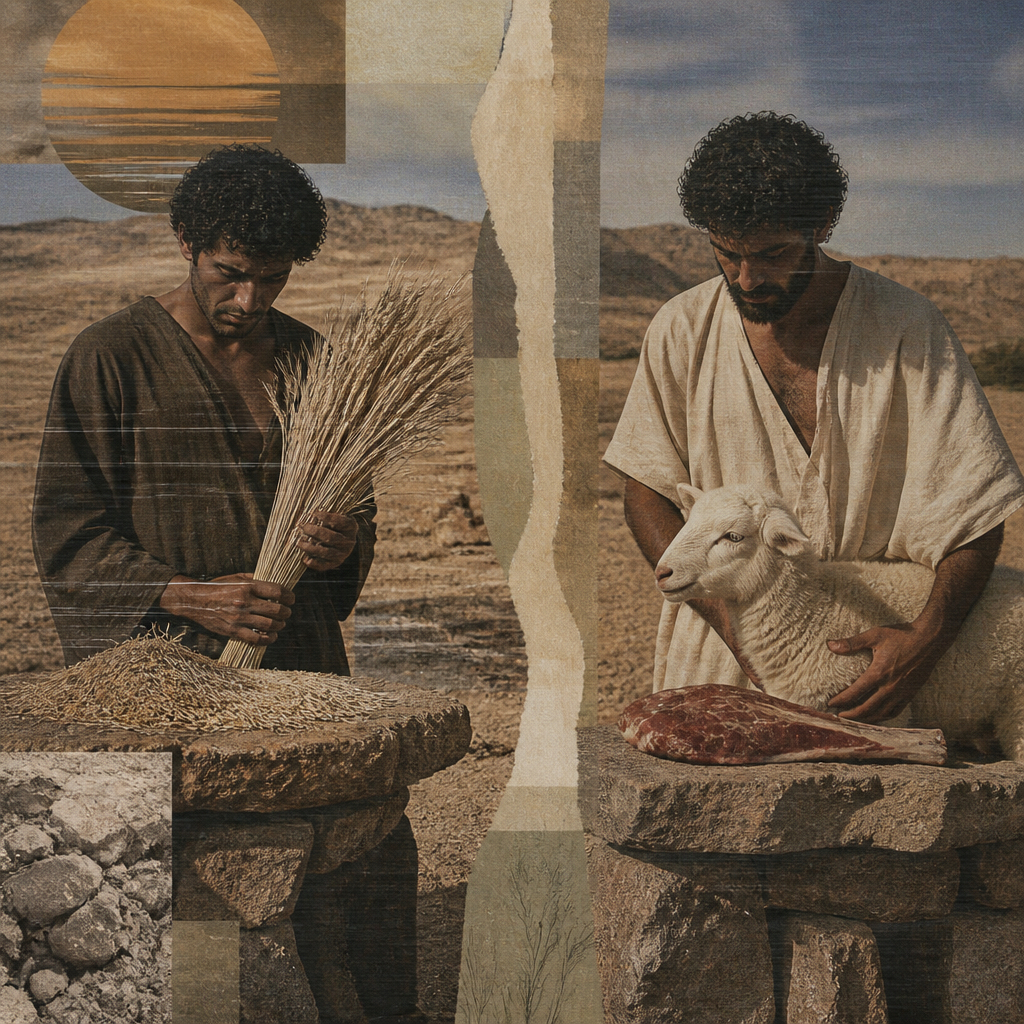
Here is a story you think you know. Two brothers. One farmer, one shepherd. They both bring offerings to God. God accepts one and rejects the other — and, intriguingly, doesn’t explain why. The rejected brother kills the favoured one. God asks where his brother is. The murderer responds with what can only be described as magnificent audacity: “Am I my brother’s keeper?” God curses him. And then — this is the part that gets quietly glossed over in every Sunday school on earth — God puts a mark on him. Not to punish him further. To protect him.
The first murderer in human history is given divine protection.
You’ve heard this story since you were a child. You’ve been told what it means. And here is the question worth sitting with: what if the most interesting thing about this story is not its theology, but its geography?
This story — this exact story, with these exact themes — was already ancient when Moses was born. It was being told in Mesopotamia two thousand years before anyone wrote down a word of Genesis.
It was being told in Egypt when the pyramids were new. Among people who had never heard of Abraham, had never set foot in the Levant, had no possible access to the Hebrew scriptures. The story of Cain and Abel is not a Jewish story. It is not a Christian story. It is not even a Middle Eastern story.
It is a human story. And the question worth asking — the one serious scholars of faith and secular historians have been circling for over a century — is simply: why?
The Intellectual Contract
Before we go anywhere together, it’s worth being clear about what kind of inquiry this is. We are not asking whether this story is true. We are not asking whether God exists. Those are theological questions, worthy ones, just not ours. Our question is simpler, and in some ways more unsettling.
Is this story unique?
Is it, as billions have been taught, a singular revelation, something that appeared once, in one place, because the divine decided to speak? Or is it part of a pattern so widespread, so ancient, and so structurally consistent across civilizations that never met, that the most honest explanation available to us is not theology, but humanity?
We will look at archaeology. We will look at textual criticism. We will look at comparative mythology, which is not a fringe hobby but a legitimate academic discipline practiced in serious universities by serious scholars. We will not mock belief. We will not caricature theology. We will not claim certainty where scholarship debates. But we will follow the evidence wherever it leads.
And the evidence, it turns out, leads somewhere remarkable.
The World That Made the Story
The version of Genesis 4 we have today did not appear fully formed from the sky. It reached its final shape in a crisis, and understanding that crisis changes everything about how the story reads.
Place yourself in the southern Levant, roughly the 9th century BCE. This is not an empire. Not Rome. Not Babylon. It is a small, landlocked kingdom — Judah — perched anxiously between larger, louder civilizations. Egypt to the south. Assyria to the north. And most people are either farmers or shepherds. That distinction is not poetic in this world. It is economic. A shepherd moves. A farmer stays. A shepherd follows grass. A farmer claims land. Two ways of surviving. Two ways of imagining what stability means.
That tension is not metaphorical. It is Tuesday.
Now hold that thought, because in 597 BCE, the world ends.
Nebuchadnezzar II of Babylon lays siege to Jerusalem. The city falls. The Temple — the architectural centre of the universe for this people, the place where heaven and earth were believed to touch — is destroyed. And a significant portion of the educated class: priests, administrators, scribes, are deported to Babylon.
- 597 BCE — JERUSALEM FALLS
- TEMPLE DESTROYED
- JUDEAN SCRIBES EXILED TO BABYLON
- THE MOST COSMOPOLITAN CITY ON EARTH
Here is where reality complicates the dramatic version. They were not dragged in chains into dungeons. Babylonian ration tablets from Nebuchadnezzar’s own palace list Judean names receiving provisions. These people were recorded, fed, accounted for. Some entered trade. Some prospered. They were not prisoners in the cinematic sense. They were displaced intellectuals, in the greatest metropolis of the ancient world.
And Babylon in the 6th century BCE is not a backwater. It has libraries. Archives. Scribal academies. The Enuma Elish — the Babylonian creation epic — is being recited in temples around them. The Epic of Gilgamesh, complete with a flood narrative that sounds suspiciously familiar to anyone who has read Genesis, is part of the literary bloodstream of the city.
Imagine being a Judean priest in exile. Your homeland is gone. Your king is gone. Your temple is rubble. And you are now living inside the cultural engine of the empire that destroyed you — surrounded by its stories, its gods, its epics, its cosmology. If you are going to preserve your people, what do you do? You write. You edit. You collect. You define. You tell your own story, carefully. And you make sure it can survive.
This is where the Priestly source — what scholars call “P” — likely does much of its work. Not inventing from nothing. But shaping, preserving, refining. Richard Elliott Friedman’s Who Wrote the Bible identifies at least four major editorial traditions behind the Pentateuch. These are not fringe ideas. They are mainstream biblical scholarship, taught in universities for over a century.
There is something almost audacious about editing Genesis in Babylon. It is like rewriting your national origin story inside the library of your conqueror.
And here’s the crucial point: these scribes were not isolated. They were immersed in the most sophisticated mythological tradition of the ancient world. Trained literate elites with exposure to Akkadian, to Mesopotamian epic structure, to royal propaganda narratives. They knew what stories could do. They knew that stories stabilize identity when geography is gone. And in that environment — surrounded by epics of divine conflict, cosmic struggle, and catastrophic resets — they refined a story about two brothers. One favoured. One resentful. One dead. One marked and wandering east.
Cain goes east. Babylon is east.
Coincidence? Possibly. Or possibly the geography of the story carries memory.
What the Text Actually Says
Now let’s do the obvious thing, which almost nobody actually does: read the story. Not the version we remember. The version that actually exists. Seventeen verses. And once you read them carefully, you may notice that the story you thought you knew is much stranger than you remember.
GENESIS 4:1–2 (ESV)
Now Adam knew Eve his wife, and she conceived and bore Cain, saying, “I have gotten a man with the help of the Lord.” And again, she bore his brother Abel. Now Abel was a keeper of sheep, and Cain a worker of the ground.
Seventeen words to establish two human beings who will carry the entire moral weight of the episode. Notice what Eve says at Cain’s birth: she names the firstborn. Abel is not named by anyone. His name simply appears. In Hebrew, hevel — Abel — means breath. Vapour. Emptiness. The transient one. The text names the second son “vapour” before he has done anything. It knows how this ends before it begins.
GENESIS 4:3–5 (ESV)
In the course of time Cain brought to the Lord an offering of the fruit of the ground, and Abel also brought of the firstborn of his flock and of their fat portions. And the Lord had regard for Abel and his offering, but for Cain and his offering he had no regard. So Cain was very angry, and his face fell.
Both brothers bring offerings. Cain from his harvest. Abel from his flock. This is not negligence — Cain is doing exactly what a farmer does. He is bringing what he has. And God accepts Abel’s and rejects Cain’s.
The text does not tell us why.
There is no sermon. No moral footnote. Just the sentence: God had regard for Abel and his offering, but for Cain and his offering, he had no regard. Scholars have been arguing about that gap for two thousand years — which tells you something important. The gap is structural. It is in the Hebrew. The story refuses to justify God.
GENESIS 4:8 (ESV)
Cain spoke to Abel his brother. And when they were in the field, Cain rose up against his brother Abel and killed him.
The first murder in human history. One sentence. No description. No weapon. No struggle. Just the fact. The most consequential act of violence in the entire biblical narrative is dispatched in a single sentence. The author has chosen not to look — and that choice is as meaningful as anything the text says directly.
Then God asks where Abel is. The omniscient God of Genesis — the same deity who knew exactly where Adam and Eve were hiding in the garden — is asking for information. Either God does not know, which raises significant theological questions, or God knows perfectly well and is giving Cain the opportunity to confess. Either way, the author has constructed a scene in which God is performing ignorance, or experiencing it. Neither option is theologically comfortable, which is possibly why this question receives so little attention at the pulpit.
And Cain says: I do not know. Am I my brother’s keeper? Seven words that have been echoing through moral philosophy ever since. Because whether we are responsible for each other turns out to be one of the central questions of civilization itself.
The Mark: The Most Misread Verse in the Bible
Here is where the careful reader should stop. Because what comes next has been misunderstood for two thousand years — and it is corrected simply by reading the verse.
GENESIS 4:13–15 (ESV)
Cain said to the Lord, “My punishment is greater than I can bear… I shall be a fugitive and a wanderer on the earth, and whoever finds me will kill me.” Then the Lord said to him, “Not so! If anyone kills Cain, vengeance shall be taken on him sevenfold.” And the Lord put a mark on Cain, lest any who found him should attack him.
Read that again. God marks the murderer. And the purpose of the mark — explicit, not implied — is to protect him. The mark of Cain has been interpreted for two millennia as a sign of shame, of criminality, of divine rejection. The text says the opposite. The text says the mark is a bodyguard.
But it goes further than that. The mark is also a law — a declaration that even the first murderer is not to be killed. The cycle of blood vengeance — you killed my brother, so I will kill you, so someone will kill me — stops here. With a mark.
In the most careful reading, the mark of Cain is the world’s first argument against capital punishment.
It is an act of radical, confounding mercy, extended by the very deity who was just offended by the murder. This is not a comfortable idea. It is also — if you look at the text — exactly what it says.
Cain then leaves. He goes east of Eden, a direction that in this text always signifies departure from order, from home. He settles in the land of Nod. In Hebrew, Nod shares its root with “wandering.” He has settled in the land of wandering. The name is the condition.
And then: Cain knew his wife.
We have just established, in the literal reading, that Adam and Eve are the first two human beings. Their children are Cain and the recently deceased Abel. There are no other people. And yet here is a woman — Cain’s wife — who the text does not explain. She simply exists, because the story needs her to. The text introduces a population it has not accounted for.
Cain builds a city. His descendants invent nomadic herding. Music. Metallurgy. The arts of civilization descend not from the righteous but from the murderer. From the cursed one. From the man who built a city in the land of wandering.
The things that make human life worth living were invented by the wrong brother’s children. Civilization does not descend from virtue. It descends from the act that made virtue necessary.
That is not a comfortable idea. It is also, if you look at human history with clear eyes, not an inaccurate one.
Four Threads Running Through History
Once you see the structure clearly, something remarkable happens. You start to notice that the story is not made of events. It is made of patterns. And those patterns appear, independently, across the ancient world.
- THREAD ONEBrother against brother — not strangers, not enemies by birth. The same blood, irreconcilably divided.
- THREAD TWOThe farmer and the herder — two incompatible ways of organizing human life, two competing claims on land, water, survival.
- THREAD THREEThe rejected offering — the cosmos plays favourites, and every culture has had to answer why.
- THREAD FOURThe first murder and the mark — intimate violence born of envy, followed by a consequence that is simultaneously punishment and protection.
Four threads. Now: how many cultures tell a version of this story?
The answer is the thing that should make you pause.
The Pattern Beyond Genesis
Among the Haudenosaunee — the Iroquois Confederacy of North America — there is a story of twins. One violent, one patient. One destructive, one a teacher. The tension between them shapes the world. In their version, the one who teaches agriculture and balance with the land wins. The farmer, not the herder. The patient one, not the violent one. A different answer to the same question.
In Sumer, a thousand years before Genesis reached its final form, there are hymns describing the rivalry between Emesh and Enten — the god of summer and the god of winter. One brings the harvest. One brings the flocks. They dispute before the divine. Their conflict is older than any Bible.
In Egypt, in Mesopotamia, in early Indian texts, in Norse myth — the same shape keeps appearing. Two figures. Divine preference. Violence or its threat. The founding of civilization in its wake. Across five thousand years and six continents, human beings who never met kept arriving at the same story.
This is either the most extraordinary coincidence in the history of human storytelling.
Or it is evidence of something far more interesting: that the story was never a revelation. It was a recognition.
Human beings across thousands of years, on every inhabited continent, kept telling a version of the same story because they were all looking at the same world — and the world kept doing the same things to them.
The tension between nomadic and settled peoples. The mystery of why some prosper and others don’t, even when effort is equal. The question of what we owe each other. The invention of civilization by people who have done terrible things. These are not theological puzzles. They are human facts. Recurring, inescapable human facts.
The Question Worth Sitting With
Here is what the text actually says. A God who plays favourites without explanation. A murder described in one sentence. A killer who is marked — and protected. A wife who appears from nowhere. A civilization built by the murderer’s children. And a question that has been hanging in the air, unanswered, for two and a half thousand years.
Am I my brother’s keeper?
Five thousand years of human civilization later, we are still trying to answer that question correctly.
What this story suggests — quietly, if you read it on its own terms — is that its authors were not recording a divine event. They were doing something more difficult and more remarkable. They were taking the chaos of human experience and giving it shape. Meaning. Narrative. They were explaining why the world looks the way it does, using the deepest structural patterns available to them — patterns that turned out to be universal, because the experience they were describing was universal.
That does not make the story less. It makes it more.
A story that belongs to one religion is the property of its believers. A story that belongs to every civilization that has ever existed is something else entirely. It is evidence. Evidence of what human beings are, what they fear, what they want, what they do to each other — and what, in their clearer moments, they understand about themselves.
The story of Cain and Abel did not come from above. It came from within. And that, it turns out, is a far more interesting place.
Next time: we open a clay tablet from ancient Mesopotamia. Three thousand years older than Genesis. A story about two rivals, two offerings, and a divine preference. A story that was already ancient when Genesis was still centuries away from being written.
Next time, we begin the comparison.
The Human Scriptures is a podcast and video series following the evidence behind humanity’s oldest shared stories.
LISTEN TO EPISODE 1 https://www.youtube.com/@TheHumanScriptures

Leave a Reply